
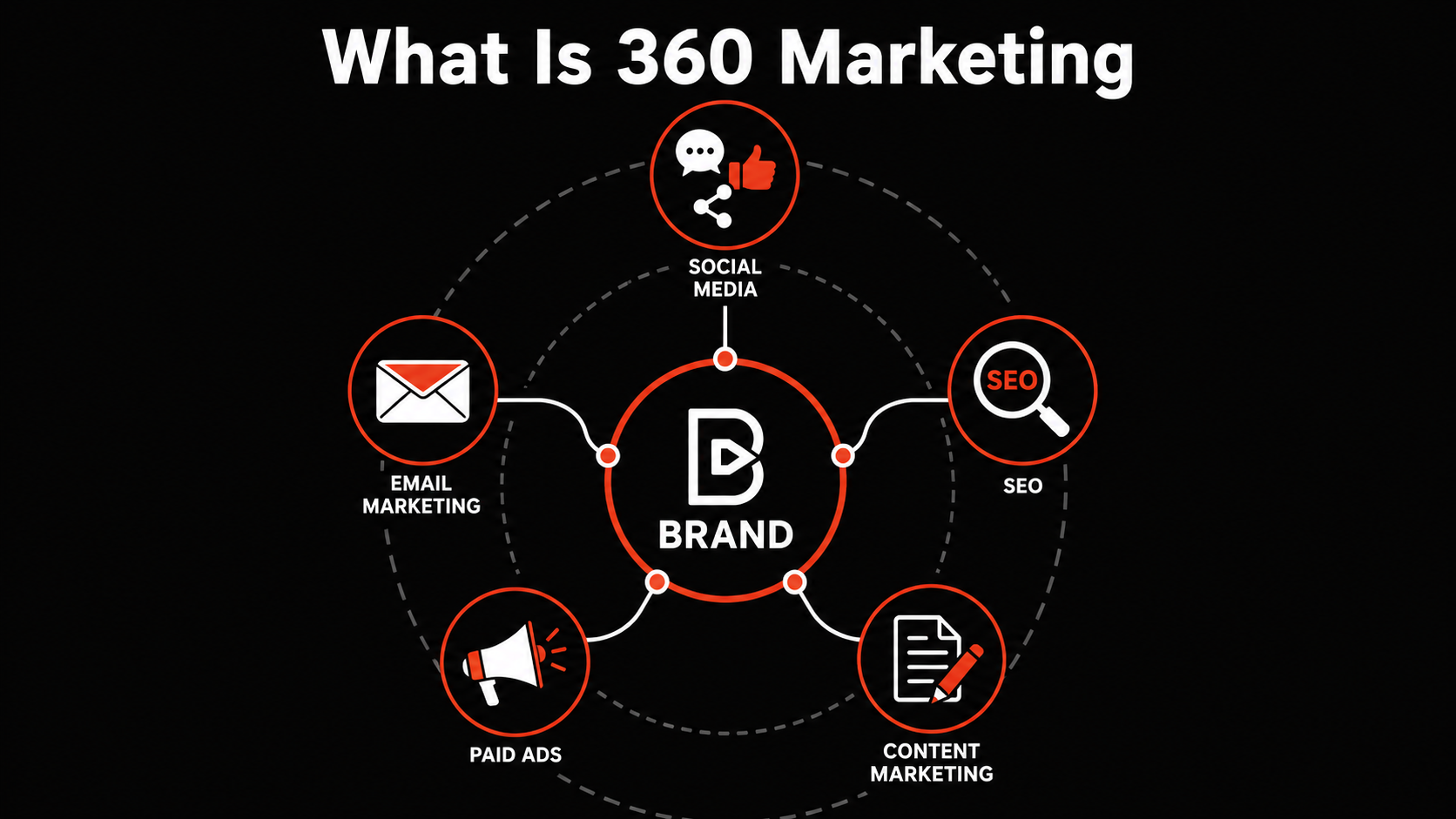
What is 360 marketing? It’s the strategy that puts your brand everywhere your audience is consistently, and with one unified message. Not just on Instagram, not just on Google, not just in your physical store. Everywhere, at the same time, with the same voice.
In this guide, we’ll break down what 360 marketing really means, how it works in practice, and why businesses that apply it properly tend to outperform those that don’t.
The 9 Key Pillars of 360 Digital Marketing
1. Holistic Approach
Every channel is part of one bigger picture. Your website, your ads, your social media posts and even your in-person interactions all carry the same brand DNA. Nothing exists in isolation.
2. Multichannel Strategy
Your audience doesn’t live on one platform, so your marketing shouldn’t either. A 360 strategy spans social media, email, SEO, paid ads, content and traditional media, creating multiple touchpoints that reinforce each other.
3. Consistent Communication
The message stays the same whether someone finds you on Instagram, Google, or walks past your store. Consistency builds recognition, and recognition builds trust.
4. User Experience
Every interaction a customer has with your brand, from clicking an ad to receiving an email to calling your office, should feel smooth and intentional. Good UX isn’t just for websites.
5. Personalization
Data lets you speak to different segments of your audience in ways that feel relevant to them. The right message, to the right person, at the right moment.
6. Analytics & Measurement
You can’t improve what you don’t measure. 360 marketing tracks performance across every channel, giving you a complete picture of what’s working and what needs adjusting.
7. Cross-Team Collaboration
Marketing, sales, content, and customer service need to operate as one unit. When teams are aligned, the customer experience reflects it.
8. Real-Time Response
Markets shift. Trends change. A 360 strategy allows you to adapt quickly — adjusting campaigns, messaging, or budget allocation without losing momentum.
9. Continuous Improvement
360 marketing is never “done.” It’s a cycle of testing, learning, and refining. The brands that commit to this process are the ones that keep growing.
The Real Benefits of 360 Marketing
When all your channels work together, the results compound. Here’s what that looks like in practice:
Your brand becomes impossible to ignore. Customers who see you on Instagram, then find you on Google, then receive your email don’t just remember you — they trust you. Repetition across channels creates familiarity, and familiarity drives decisions.
Your budget works harder. When channels are aligned, each one reinforces the others. A customer who saw your ad is more likely to open your email. A customer who read your blog is more likely to click your Google Ad. Nothing works in isolation — and that’s the point.
You get a complete picture of your customer. Data from multiple channels gives you insights that a single-channel approach never could. You start to understand not just who your customer is, but how they move, what they respond to, and when they’re ready to buy.
Τhe Challenges & How to Handle Them
360 marketing isn’t without its difficulties. The most common challenge is consistency. With multiple channels in play, maintaining the same tone, visuals, and message across all of them requires clear brand guidelines and tight coordination between everyone involved.
It also requires investment — not just in tools and platforms, but in time. Managing a 360 strategy is not a part-time job. It demands ongoing attention, regular analysis, and the willingness to adapt when something isn’t performing.
Finally, the volume of data generated across multiple channels can be overwhelming without the right systems in place. Knowing which metrics matter and how to act on them is a skill in itself.
The good news? These are exactly the challenges that a good agency exists to solve.
Conclusion
To conclude, 360 marketing isn’t a luxury reserved for big brands with large budgets. It’s a strategic choice that any business can make — to stop treating their channels as separate efforts and start building something that works as a whole.
If you’re ready to stop doing marketing in pieces and start doing it properly, we’re here to help.
Contact Inglelandi today and let’s build your 360 strategy together.
Frequently Asked Questions (FAQs)
1. What is 360 marketing?
It’s an integrated marketing strategy that connects all your channels — online and offline — into one unified, consistent approach designed to reach your audience at every touchpoint.
2. What are the main benefits?
Stronger brand recognition, higher customer trust, smarter use of your budget, and a complete understanding of your customer journey.
3. How do I start with a 360 strategy?
Begin by auditing your current channels, defining your brand voice and visual identity, then build campaigns that connect across all touchpoints. Measuring results from the start is essential.
4. Is 360 marketing suitable for small businesses?
Absolutely. The scale adapts to your resources. A small business doesn’t need to be on every platform — it needs to be consistent on the ones that matter most for its audience.
5. How is it different from traditional marketing?
Traditional marketing typically focuses on one or two channels in isolation. 360 marketing creates a connected experience across all of them, with the customer journey at the center.