
GEO and SEO is a topic more and more businesses are exploring as they look to strengthen their online presence. Any company operating in the digital space knows how important it is to have a website that’s properly optimized for search engines like Google. For years, SEO has been the foundation of organic visibility, helping brands rank higher and attract consistent website traffic.
But what is GEO? And why is it suddenly part of the conversation?
In this article, we’ll explain what GEO means, how it differs from SEO, and why combining both is the next step in modern digital strategy.
What Is GEO and How Is It Different from SEO?
Before defining GEO, let’s briefly revisit SEO. SEO (Search Engine Optimization) is the process of optimizing a website so it appears high in organic search results on platforms like Google or Bing. The goal is clear:
- Increase organic traffic
- Improve keyword rankings
- Strengthen brand credibility
For years, this has been one of the core visibility strategies online. However, the way users search is evolving. This is where GEO (Generative Engine Optimization) comes in. GEO focuses on optimizing content for AI-driven tools such as ChatGPT, Gemini, and other AI search assistants. Instead of targeting only search result pages, GEO aims to make your brand appear inside AI-generated answers.
The way we search has changed. Users no longer see the top 10 search results at first; instead, they receive an answer (AI Overview) generated from selected sources. And that’s exactly where your brand needs to appear. Below is an example where a blog from Inglelandi (“What is a Hook in a Video? The Secret to Capturing Attention”) appears as a cited source inside an AI-generated response.
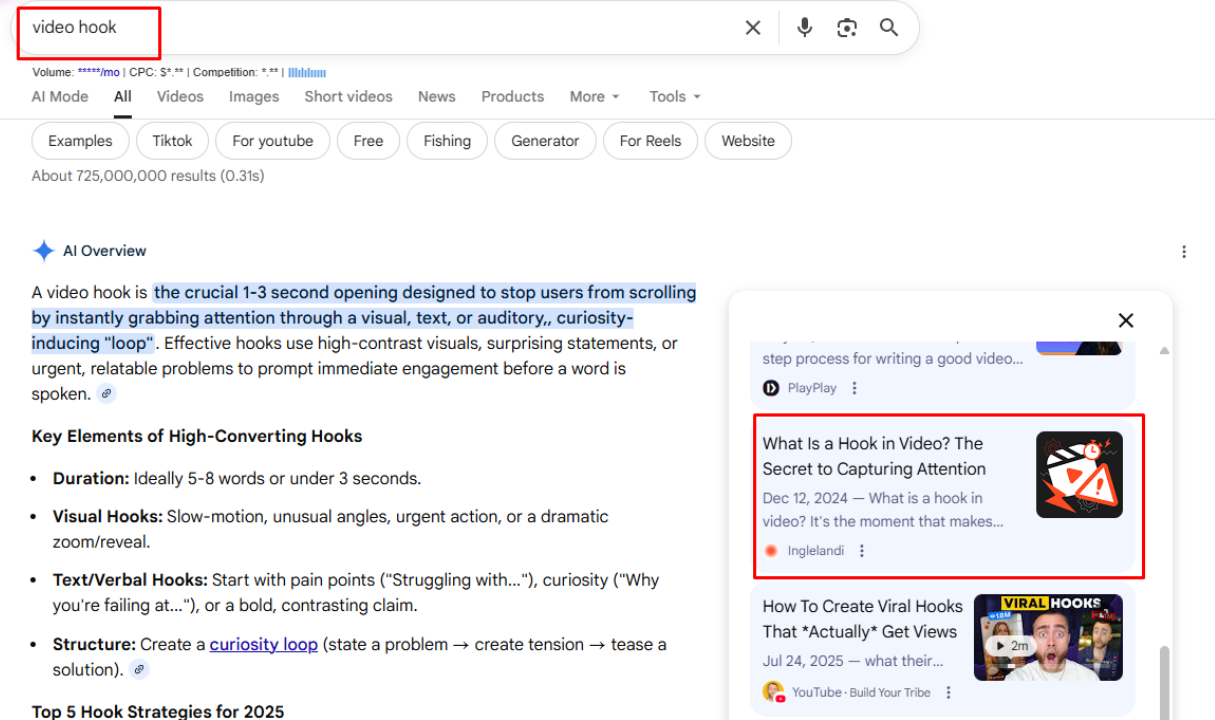
The concept of GEO has been widely discussed recently, especially with the rapid growth of AI search. In a related discussion on Moz (“If You’ve Been Investing in SEO, You’re on the Right Track With GEO: An AMA With Lily Ray”), it is highlighted that a large portion of GEO (around 90%) relies on traditional SEO practices, such as:
- Creating high-quality, original content
- Strengthening brand authority
- Focusing on EEAT (Experience, Expertise, Authoritativeness, Trustworthiness)
In simple terms, if you are applying SEO practices correctly, investing in valuable content and building brand credibility, you already have a strong foundation for GEO.
GEO and SEO: Key Differences
Below is a simplified comparison of geo and seo:
| SEO (Search Engine Optimization) | GEO (Generative Engine Optimization) | |
| Where You Appear | Organic search results (Google, Bing, etc) | Inside AI-generated answers |
| Format | List of results | Single synthesized answer with sources |
| Goal | Rank for keywords | Be cited as a source |
| Content Strategy | Keyword optimization | Question-based optimization |
| User Behavior | User chooses a link | User receives a direct answer |
| Success Metrics | Rankings, CTR, traffic | AI visibility, citations, mentions |
| Competition | Compete for rankings | Compete for reference |
How Inglelandi Adapts to GEO and SEO
At Inglelandi, we closely follow the evolution of SEO and the transition toward AI-driven search results. We have already adapted how we structure and produce content so it performs well in both traditional search engines and AI environments. We focus on:
- Logical structure and clarity
- Direct, useful answers
- Information credibility
- Topical authority
Our goal is simple: Content that remains relevant, visible, and valuable regardless of how search technology evolves.
Conclusion
To conclude, the debate around geo and seo is not about choosing one over the other. SEO remains the foundation of digital visibility. Without technical optimization, structured content, and authority, long-term online presence is impossible. GEO reflects the new reality. Users increasingly receive instant AI-generated answers based on trusted sources. The right strategy is not to replace SEO with GEO. It is to build a content ecosystem that performs in both traditional search results and AI-generated environments.
If you want to adapt your strategy to the future of search, contact us today!
Discover our Social Media HERE!
Want more marketing insights? Click HERE to explore all our blog posts!
Frequently Asked Questions (FAQs)
1. Is GEO completely different from SEO?
No. GEO builds on SEO principles but focuses on visibility within AI-generated answers rather than traditional rankings.
2. Do I need to change my entire strategy for GEO?
Not necessarily. If you already invest in structured, high-quality content and authority, you are on the right track.
3. How can my content appear in AI-generated answers?
By providing clear structure, direct answers, trustworthy information, and strong topical relevance.
4. Will SEO stop working because of AI search?
No. SEO is evolving, not disappearing. Organic search and AI-generated answers now coexist.
5. What is the main difference between GEO and SEO?
SEO competes for ranking positions. GEO competes for citations inside AI-generated responses.